Agentic AI & Automation

Agentic Solution Design & Build

Agents that finish the task, not chatbots that answer questions about it.

Trusted Partners

What an agentic solution actually is

An AI agent is a system that completes work rather than answering questions about it. It retrieves information, reasons over it, calls tools and systems, takes actions that change state, and stops for a human at the points where that matters. The distinction that counts commercially is the state change. A chatbot that gives a wrong answer creates a bad experience. An agent that takes a wrong action creates a liability. That is why our build practice and our governance practice are the same practice.

01

Anatomy of an AI agent
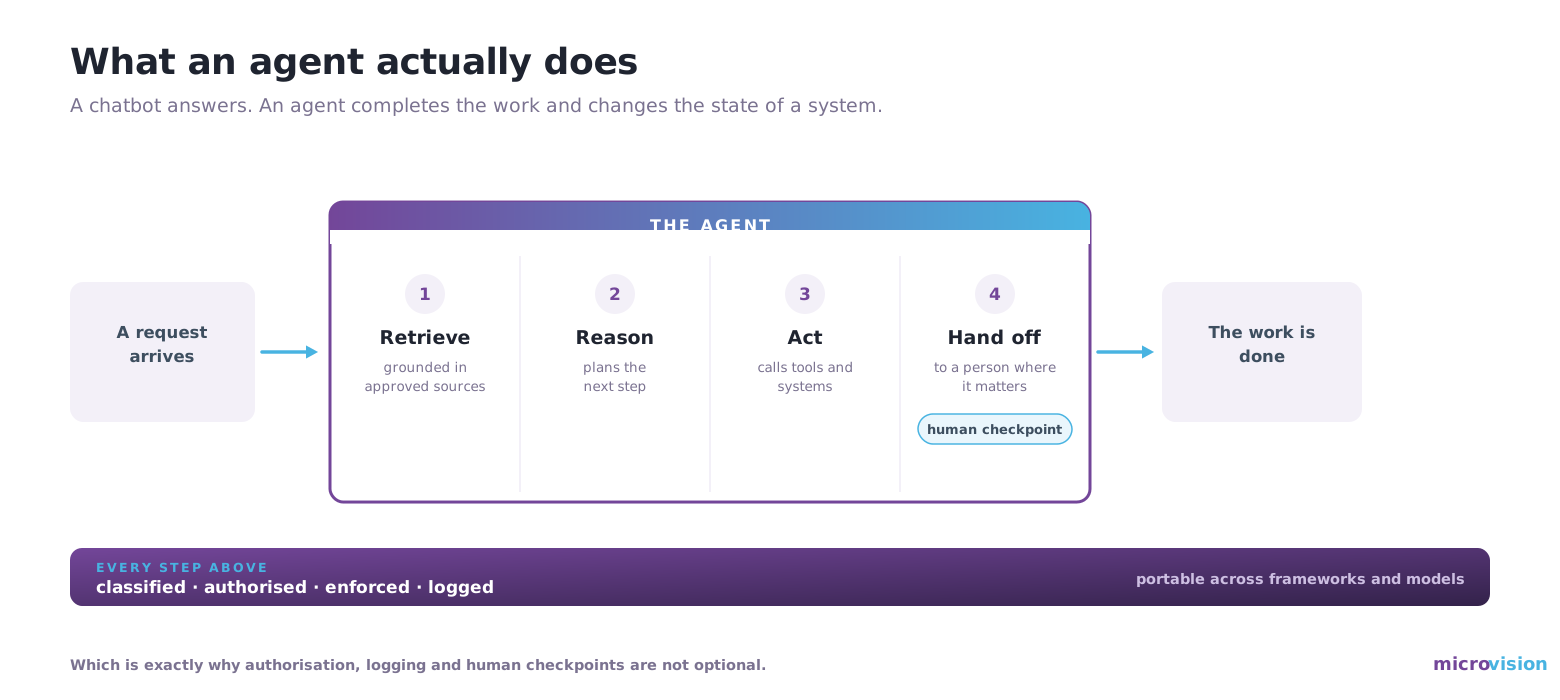
Anatomy of an AI agent: retrieve, reason, act and hand off to a human, with every step classified, authorised, enforced and logged.

02

How we build

  • Journey design first. We map the task end to end before writing anything, including the exception paths, which is where most agents fail.
  • Tool and system design. Each capability the agent can reach is defined, scoped and least-privileged before it is connected.
  • Human checkpoints by design. Decision classes that an agent may never take alone are agreed at the start, not discovered at review.
  • Grounded retrieval. Answers and decisions are traced to approved sources, so the agent cannot invent policy.
  • Evaluation from day one. A test set exists before the agent does, so quality is measured rather than asserted.
  • Bilingual by default. Arabic and English are built in, not retrofitted.
03

Portable by design

We do not tie your solution to a single vendor. The runtime is abstracted so the same agent runs on open frameworks or on a managed platform, and models remain swappable, including sovereign and open-weight options.

This is a deliberate architectural decision rather than a preference. The agent stack is changing faster than any procurement cycle, so coupling your service to one vendor’s roadmap is a liability you would be carrying for years.

04

What you receive

  • A working service in production, not a proof of concept.
  • The agent, its tools, its prompts and its policies, all version-controlled and documented.
  • An evaluation harness with a maintained test set.
  • Runbooks and administration documentation, so your team can operate what we built.
05

Frequently asked questions

What is the difference between an AI agent and a chatbot?
A chatbot answers. An agent acts. An agent retrieves information, reasons over it, uses tools and systems, and changes the state of something: it submits an application, issues a certificate, books a facility, routes an approval. Because it changes state, it needs authorisation, logging and human checkpoints, which a chatbot does not.

How long until an agent is live?
A first production service typically takes one quarter, covering assessment, the governance layer and one complete end-to-end service. Subsequent services are substantially faster because the platform, connectors and policies already exist. The second service is configuration rather than invention.

Are we locked into one AI model or framework?
No. The runtime is abstracted and models are swappable, including in-country sovereign and open-weight models. A model or vendor change becomes a configuration decision rather than a rebuild.

Can an agent work with our existing approval rules?
Yes, and it should. Approval routing, delegation and escalation are modelled explicitly rather than learned, so the agent follows the same rules your staff do, and you can read those rules without opening the code.

Rethink What's Possible with Cloud Services