Agentic AI & Automation

Citizen & Employee Experience

An assistant is only useful if people finish what they started.

Trusted Partners

Completion is the only metric that matters

Experience design for AI services is the practice of making an assistant usable enough that people complete the task, measured by completion rate rather than by satisfaction with the technology. An assistant that is technically correct and practically abandoned has solved nothing. The failure is rarely the model. It is an interface that assumes the user already knows the vocabulary of the organisation, a journey that restarts when a document is missing, or an Arabic experience that was translated rather than designed.

01

Before and after
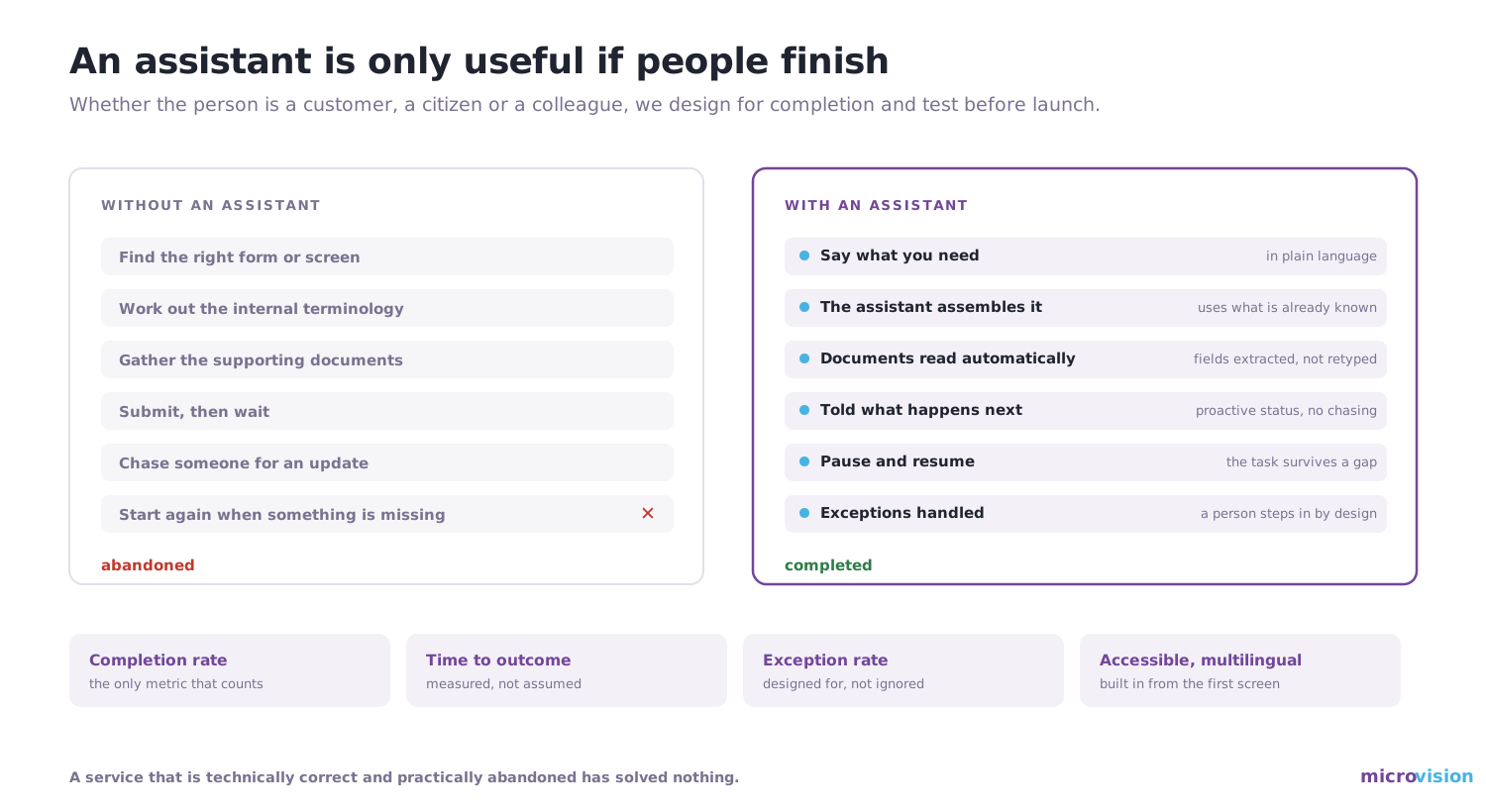
Comparison of a traditional service journey that ends in abandonment against an AI assistant journey that ends in completion.

02

What we design

  • Natural-language intake. The applicant describes what they need in their own words instead of completing a form, and the assistant assembles the structured request.
  • Arabic-first bilingual design. Arabic treated as a primary experience with correct right-to-left layout and terminology, not a translation layer added at the end.
  • Accessibility to WCAG AA. Built in from the first screen, which is both a public-sector obligation and a measurable improvement for every user.
  • Continuity over restart. A journey that can be paused, resumed and recovered when information is missing.
  • Designed for exceptions. The unusual case is handled gracefully rather than dumped on a call centre.
  • Proactive status. The applicant is told what happened and what comes next, which removes most of the chasing.
03

Tested with real users before launch

We run usability testing with actual users, not internal reviewers, before a service goes live. Task completion, time on task and the points where people give up are measured and designed against.

This is also the cheapest stage at which to find a problem. A journey flaw found in testing costs a day; the same flaw found after launch costs a public service incident.

04

How we differ

Most AI delivery treats the interface as the last five percent. We treat adoption as the deliverable, because an entity is judged on whether citizens used the service, not on whether the model was accurate.

05

Frequently asked questions

Why does an AI assistant need accessibility work if it is conversational?
Because conversation is only one of the channels. Users still read status, upload documents, review summaries and confirm decisions on screen. Those surfaces carry the same accessibility obligations as any other public service, and for many users they are the primary interaction.

Is Arabic support just translation?
No, and treating it as translation is the most common reason Arabic services underperform. Arabic requires right-to-left layout, correct administrative terminology, bilingual document handling and testing with Arabic-speaking users. We design it as a first-class experience rather than a localisation pass.

How do you measure whether the assistant is working?
By completion rate, time to outcome, exception rate and the proportion of journeys that need human intervention. Satisfaction scores are useful context, but completion is the measure that tells you whether the service replaced the old way of working.

Rethink What's Possible with Cloud Services