Agentic AI & Automation

Legacy & Systems Integration

The processes worth automating usually sit behind the systems that are hardest to reach.

Trusted Partners

Where automation programmes actually stop

Legacy integration for AI is the work of connecting an agent to systems that were never designed to be called by one, either through a modern interface where it exists or by driving the existing user interface where it does not. The uncomfortable pattern in most organisations is that the processes with the highest return are the ones running on the oldest platforms. The modern, well-documented systems are usually already efficient. The expensive, manual, error-prone work tends to sit on something that predates the API era, which is exactly where most automation programmes quietly stop.

01

Two routes in
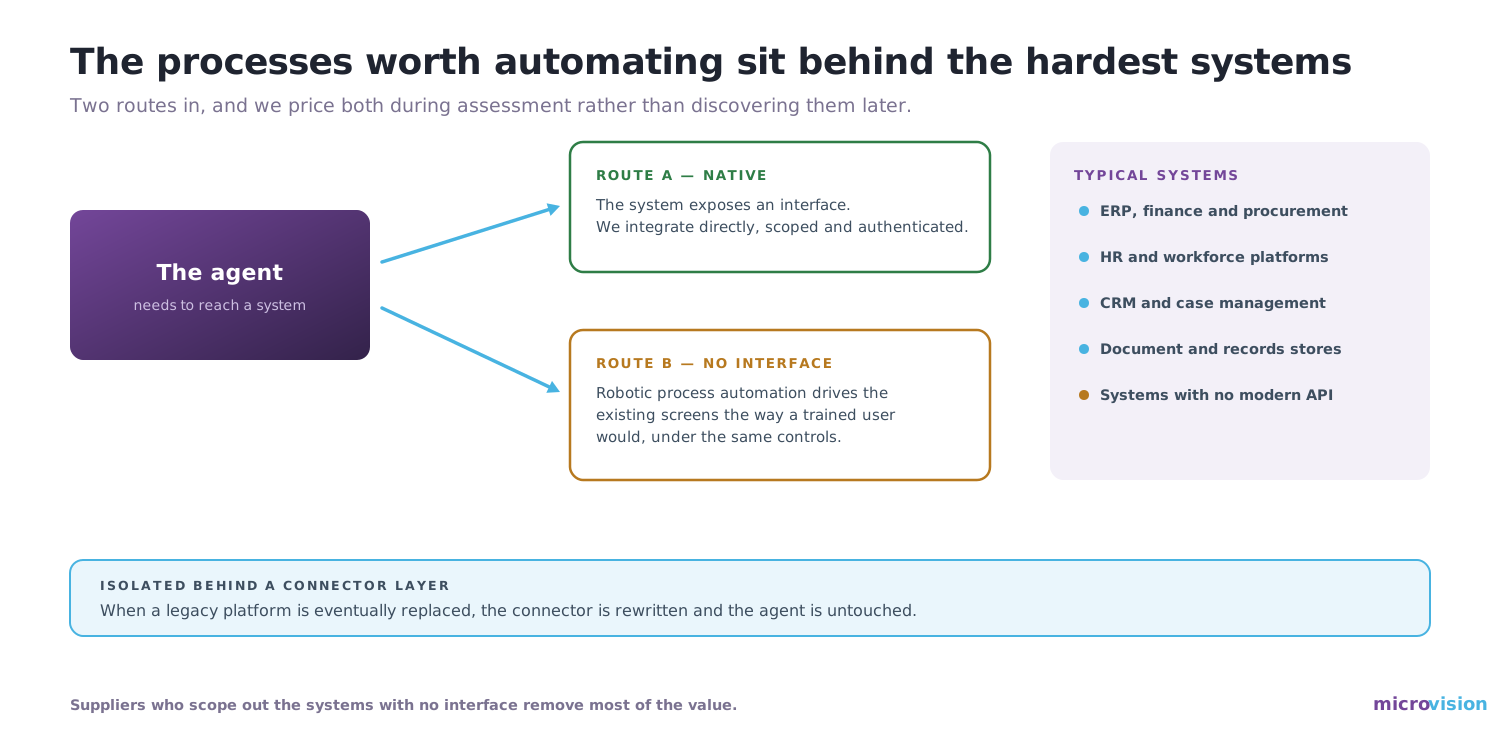
Two integration routes for AI agents: native API integration where an interface exists, and robotic process automation where none does, isolated behind a connector layer.

02

How we connect

  • Native integration first. Where a system exposes an interface, we use it, with proper authentication, scoping and error handling.
  • Robotic process automation where no interface exists. The agent drives the existing screens the way a trained user would, reliably and under supervision.
  • National and federal platforms. Identity and credential verification through national identity services, and connectors to shared federal systems.
  • Document and file pathways. Where the only integration is an inbox or a folder, we treat that as an interface and make it reliable.
  • Retrieval and data stores. A governed source of truth the agent can reason over without reaching into production systems directly.
03

Built to survive the system being replaced

We assume every legacy system in scope will eventually be replaced, so integration is isolated behind a connector layer. When the underlying platform changes, the connector is rewritten and the agent is untouched.

This matters commercially. It means a modernisation programme running in parallel does not invalidate the AI work, and the two can proceed without blocking each other.

04

How we differ

Many suppliers quietly scope out the systems that have no interface, which removes most of the value from the programme. We treat those systems as the point of the exercise rather than an exclusion, and we price that work openly during assessment rather than discovering it later.

05

Frequently asked questions

Can AI work with legacy systems that have no API?
Yes. Where a modern interface exists we integrate natively. Where none exists, robotic process automation drives the existing interface under supervision, with the same logging and authorisation controls as any other action. Most high-value processes in established organisations depend on systems in the second category.

Is RPA not outdated now that we have AI agents?
They solve different problems and work best together. An agent decides what should happen; RPA is one of the ways it makes that happen when a system offers no other route. Using an agent to reason and RPA to act is considerably more robust than either alone.

What happens when we eventually replace the legacy system?
The integration sits behind a connector layer, so the connector is rewritten and the agent, its policies and its evidence are unaffected. Modernisation and AI work can proceed in parallel without blocking each other.

Rethink What's Possible with Cloud Services